MY ASTROPHOTOGRAPHY JOURNEY
The year was 1952 and at age 14 I finished building my first telescope, a 2-inch refractor with a cheap lens on a wobbly tripod…but at least it was something I could look through to see more detail on the Moon and planets. The telescope was the result of a budding interest in astronomy that began taking root several months before. My parents took note of this interest and my efforts and gave me for Christmas a 3.5-inch commercially made Newtonian reflector called a “SkyScope.” With a very simple but sturdy and efficient mount and with far superior optics to my little refractor, I began to see the universe with a whole new “eye.” I was absolutely fascinated, and became hooked on a hobby that has remained a life-long endeavor.
My first foray into astrophotography happened my junior year of high school. I took photos of the Moon through a 6-inch Newtonian reflector I had built. I entered it and the photos (that were developed and printed by a student photographer friend) into Santa Barbara High School's first science fair. To my great surprise, I won first place. Certainly encouraged, the time I had to devote to this new-found interest evaporated, drained away by the pressing demands of college and later graduate school (I am professionally trained in theology and psychology with a Ph.D. in clinical psychology). My interest in astronomy waxed and waned over the years as I spent time with my family, built my psychotherapy practice, and pursued other interests. Because of the lack of suitable observing sites and the demands made by film for custom developing and printing, which would require a darkroom, astrophotography seemed like a daunting undertaking. So I stayed away, with my dreams of photographing the Cosmos languishing in the background.
Then everything changed. Along came the digital revolution. For Christmas, 2001, my wife gave me a state-of-the-art digital camera. Amazed at the ability of this camera combined with my computer (that now became my "darkroom") to produce high quality photos, I began to think of astrophotography possibilities. Then the following Christmas I received another fabulous gift from my wife (bless her!)--an 11-inch Celestron NexStar GPS Schmidt-Cassegrain telescope (SCT). Shortly after getting this scope set up and becoming accustomed to its operation, I began to experiment taking photos of the Moon and planets and processing the results on my computer. I was excited by the results!
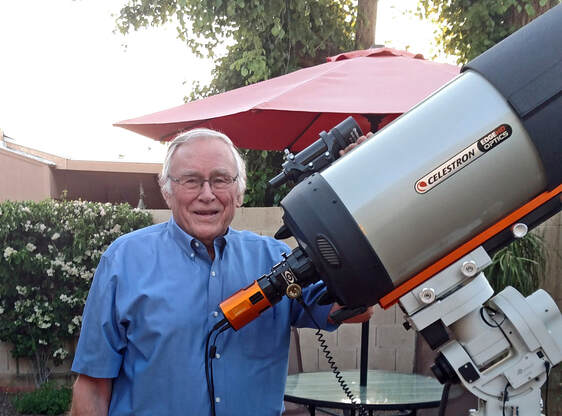
So, since early 2003, I've continued to refine my work with new cameras, new telescopes, new telescope mountings, an auto-guider, and new computer programs written expressly for amateur astrophotographers, culminating with the Celestron 11-inch Edge SCT and iOptron CEM 60 mounting shown above. And all the time thrilling to the beauty and majesty of the Universe unfolding through photos of ever increasing quality that are the result of hours of experimentation and study.
The images I'm now able to record (most of which were made from my backyard in Santa Barbara, CA, and now from Scottsdale, AZ) and process have exceeded by far anything I could possibly imagine when I was younger. I thank God I have had such a remarkable opportunity to create these Images From The Cosmos, a personally obtained visual record of his creation...and to share them with you!
CONTACT ME
If you have any questions or comments, please contact me at starryrobert@aol.com
USEFUL LINKS
Santa Barbara Astronomical Unit (SBAU) www.sbau.org
The local Santa Barbara astronomy club's website that contains much interesting, useful astronomical information and numerous helpful links.
Sky and Telescope magazine www.skyandtelescope.com
Website for the leading astronomy magazine for amateurs, including many informative links.
Astronomy magazine www.astronomy.com
The other popular astronomy magazine founded after Sky and Telescope and focused more on the general public.
Oceanside Photo and Telescope, Inc. www.optcorp.com
Southern California dealer that carries a wide variety of telescopes, cameras, and accessories at great prices.
Celestron Telescopes www.celestron.com
Everything having to do with Celestron telescopes and accessories.
Orion Telescopes www.oriontelescopes.com
Manufactures telescopes, eyepieces, mounts, autoguiders, filter wheels and a variety of other accessories at reasonable prices.
Starizona www.starizona.com
Sells a wide variety of telescopes and astrophotography items. Manufactures the HyperStar lens that may be used with the Fastar configuration of Celestron Schmidt-Cassegrain telescopes.
iOptron www.iOptron.com
Mainly known for their high-quality and reasonably priced equatorial mountings, including the innovative
center-balanced (CEM) mountings. Their mountings, which are relatively light weight, can handle small to
heavy payloads. All the mountings have excellent pointing and tracking characteristics.
Atik Cameras www.atik-cameras.com
Atik's website displaying their full line of astronomical cameras.
* * *
SUGGESTED READING
Seip, Stephan (2008) Digital Astrophotography: A Guide to Capturing the Cosmos. Santa Barbara: Rocky Nook, Inc. A great introduction, this volume covers DSLR cameras, webcams, and CCD cameras explaining which particular camera is best suited for which astronomical object being photographed. This overview will help the beginning astrophotographer decide what camera to choose based on his or her photographic interests.
If you decide to use a DSLR then read,
Covington, Michael A. (2007) Digital SLR Astrophotography. Cambridge: Cambridge University Press. An excellent guide showing how to use a DSLR camera with a telescope and how to process the resulting images. Well illustrated and written with many helpful hints.
A great instructional CD if you use a DSLR is,
Lodriguss, Jerry. (2006) A Guide to Astrophotography with Digital SLR Cameras. Somerdale, NJ: www.astropix.com This is an excellent introduction and guide for the use of DSLR cameras with telescopes and for the subsequent processing of photos. Contained on the CD are links to websites that will show you the latest cameras available, so the CD does not go out of date in that regard. In addition, he has more recently released a CD on photographing the planets titled A Guide to DSLR Planetary Imaging (2012).
In addition you should read,
Wodaski, Ron. (2002) The New CCD Astronomy: The Revolution in Astrophotography. Duvall, WA: New Astronomy Press. Though one of the earlier books published dealing with digital astrophotography before DSLR cameras were on the market, the book contains a wealth of important information on the basics of astrophotography regardless of the type of camera used. Contains many helpful black and white illustrations and drawings.
Once you begin taking images read,
Kier, Ruben. (2009) The 100 Best Astrophotography Targets: A Monthly Guide for CCD Imaging with Amateur Telescopes. This excellent guide is valuable whether you use a DSLR or CCD camera. It presents favorite targets for astrophotography by the month that they cross the meridian, that is, are highest in the sky. The book also contains helpful information about the object, exposure times based on Kier's equipment, and a section at the end of the book dealing briefly with the important aspects of CCD imaging, much of which can be applied also to DSLR imaging. Kier is a highly experienced astrophotographer using sophisticated equipment and software, and he gets great results. But don't be discouraged if your initial efforts fall far short of his images!
COPYRIGHT NOTICE All photos and text copyright 2020 by Robert C. Richard and may not be used for any purpose without the explicit written consent of the author. If you have interest in any of the photos, please contact me so we can arrange for you to use them in a way that is mutually understood and acceptable to all parties.
My first foray into astrophotography happened my junior year of high school. I took photos of the Moon through a 6-inch Newtonian reflector I had built. I entered it and the photos (that were developed and printed by a student photographer friend) into Santa Barbara High School's first science fair. To my great surprise, I won first place. Certainly encouraged, the time I had to devote to this new-found interest evaporated, drained away by the pressing demands of college and later graduate school (I am professionally trained in theology and psychology with a Ph.D. in clinical psychology). My interest in astronomy waxed and waned over the years as I spent time with my family, built my psychotherapy practice, and pursued other interests. Because of the lack of suitable observing sites and the demands made by film for custom developing and printing, which would require a darkroom, astrophotography seemed like a daunting undertaking. So I stayed away, with my dreams of photographing the Cosmos languishing in the background.
Then everything changed. Along came the digital revolution. For Christmas, 2001, my wife gave me a state-of-the-art digital camera. Amazed at the ability of this camera combined with my computer (that now became my "darkroom") to produce high quality photos, I began to think of astrophotography possibilities. Then the following Christmas I received another fabulous gift from my wife (bless her!)--an 11-inch Celestron NexStar GPS Schmidt-Cassegrain telescope (SCT). Shortly after getting this scope set up and becoming accustomed to its operation, I began to experiment taking photos of the Moon and planets and processing the results on my computer. I was excited by the results!
So, since early 2003, I've continued to refine my work with new cameras, new telescopes, new telescope mountings, an auto-guider, and new computer programs written expressly for amateur astrophotographers, culminating with the Celestron 11-inch Edge SCT and iOptron CEM 60 mounting shown above. And all the time thrilling to the beauty and majesty of the Universe unfolding through photos of ever increasing quality that are the result of hours of experimentation and study.
The images I'm now able to record (most of which were made from my backyard in Santa Barbara, CA, and now from Scottsdale, AZ) and process have exceeded by far anything I could possibly imagine when I was younger. I thank God I have had such a remarkable opportunity to create these Images From The Cosmos, a personally obtained visual record of his creation...and to share them with you!
CONTACT ME
If you have any questions or comments, please contact me at starryrobert@aol.com
USEFUL LINKS
Santa Barbara Astronomical Unit (SBAU) www.sbau.org
The local Santa Barbara astronomy club's website that contains much interesting, useful astronomical information and numerous helpful links.
Sky and Telescope magazine www.skyandtelescope.com
Website for the leading astronomy magazine for amateurs, including many informative links.
Astronomy magazine www.astronomy.com
The other popular astronomy magazine founded after Sky and Telescope and focused more on the general public.
Oceanside Photo and Telescope, Inc. www.optcorp.com
Southern California dealer that carries a wide variety of telescopes, cameras, and accessories at great prices.
Celestron Telescopes www.celestron.com
Everything having to do with Celestron telescopes and accessories.
Orion Telescopes www.oriontelescopes.com
Manufactures telescopes, eyepieces, mounts, autoguiders, filter wheels and a variety of other accessories at reasonable prices.
Starizona www.starizona.com
Sells a wide variety of telescopes and astrophotography items. Manufactures the HyperStar lens that may be used with the Fastar configuration of Celestron Schmidt-Cassegrain telescopes.
iOptron www.iOptron.com
Mainly known for their high-quality and reasonably priced equatorial mountings, including the innovative
center-balanced (CEM) mountings. Their mountings, which are relatively light weight, can handle small to
heavy payloads. All the mountings have excellent pointing and tracking characteristics.
Atik Cameras www.atik-cameras.com
Atik's website displaying their full line of astronomical cameras.
* * *
SUGGESTED READING
Seip, Stephan (2008) Digital Astrophotography: A Guide to Capturing the Cosmos. Santa Barbara: Rocky Nook, Inc. A great introduction, this volume covers DSLR cameras, webcams, and CCD cameras explaining which particular camera is best suited for which astronomical object being photographed. This overview will help the beginning astrophotographer decide what camera to choose based on his or her photographic interests.
If you decide to use a DSLR then read,
Covington, Michael A. (2007) Digital SLR Astrophotography. Cambridge: Cambridge University Press. An excellent guide showing how to use a DSLR camera with a telescope and how to process the resulting images. Well illustrated and written with many helpful hints.
A great instructional CD if you use a DSLR is,
Lodriguss, Jerry. (2006) A Guide to Astrophotography with Digital SLR Cameras. Somerdale, NJ: www.astropix.com This is an excellent introduction and guide for the use of DSLR cameras with telescopes and for the subsequent processing of photos. Contained on the CD are links to websites that will show you the latest cameras available, so the CD does not go out of date in that regard. In addition, he has more recently released a CD on photographing the planets titled A Guide to DSLR Planetary Imaging (2012).
In addition you should read,
Wodaski, Ron. (2002) The New CCD Astronomy: The Revolution in Astrophotography. Duvall, WA: New Astronomy Press. Though one of the earlier books published dealing with digital astrophotography before DSLR cameras were on the market, the book contains a wealth of important information on the basics of astrophotography regardless of the type of camera used. Contains many helpful black and white illustrations and drawings.
Once you begin taking images read,
Kier, Ruben. (2009) The 100 Best Astrophotography Targets: A Monthly Guide for CCD Imaging with Amateur Telescopes. This excellent guide is valuable whether you use a DSLR or CCD camera. It presents favorite targets for astrophotography by the month that they cross the meridian, that is, are highest in the sky. The book also contains helpful information about the object, exposure times based on Kier's equipment, and a section at the end of the book dealing briefly with the important aspects of CCD imaging, much of which can be applied also to DSLR imaging. Kier is a highly experienced astrophotographer using sophisticated equipment and software, and he gets great results. But don't be discouraged if your initial efforts fall far short of his images!
COPYRIGHT NOTICE All photos and text copyright 2020 by Robert C. Richard and may not be used for any purpose without the explicit written consent of the author. If you have interest in any of the photos, please contact me so we can arrange for you to use them in a way that is mutually understood and acceptable to all parties.